Tuesday, March 15, 2016

The other choice

So I knew I would have some students that didn't want to do quilling, and I had a couple of them that had done it before.  There lies the problem with a few of them taking my classes every year.

So the alternative project that I gave out was weaving.  I know what you are thinking, that is so easy.  Why even try quilling if the other option was weaving?  Well I did make it challenging.  They either had to weave unusual mediums together, or they had to find some way to make it complicated.  Of course most chose to create a material out of dried house paint.  If you have never done this, it is kind of cool.  I bought a board to do it on this year, but waxed paper does work.  So anyways, you spread a couple of kinds of house paint out into a big pool of area and then let it dry.  Depending on how thick you make it, it might take a couple of days to dry.  Once it is dry, you can cut it into strips.

Danica H.

Lexi B.

These two ladies decided to take their two different attach their woven paint to paper and then decorate with chalk pencils.

Friday, March 11, 2016

Quill me some art

I love the look and technique of quilling.  It is one of the simplest and yet can be the most stressful thing you do.  I usually tell my students to cut out several strips and then take them home, turn on a movie and just roll them while they watch tv.  I know that is probably not the best thing a teacher should tell their students to do in this day and age of obesity, but that is also why I assign this project during the heart of winter.  Who wants to go outside anyways?  If you didn't guess, I am not a winter girl, but yes I live in South Dakota.

Anyways,  here are a few of my favorite quilling assignments that came in.  I don't think I sold the project as well as I have in the past.  This year it didn't feel like they gave their all.  If anyone has any suggestions, I am all ears.

Austin L.

Drea B.

Sydney H.

Will S.

Monday, March 7, 2016

Mix em up and call it art

So how else do you describe Cubism?  I know there is a more technical term, but in the end you pretty much mix em up and call it art.  At least that is how one of my high school students tried to explain it.

So after we talked about Pablo Picasso and Georges Braque, in a little bit more detail, I had the students try to put some mixed up pictures together the best they could.  Of course it takes them a minute or two to realize that not all of the pieces are there and there are a few extra pieces from other pictures.  But I still make them try to form a coherent picture with hall of the pieces given.

We then take out our sketchbooks and practice using and blending oil pastels.  I have them draw 9 unusual shapes in their sketchbooks and then they had to practice different techniques in each shape with different colors.  I let them know this is their chance to see what colors work well together.

I then have them find and print off an animal, insect or fish.  I tell them to make sure to make it big enough, usually as big as they can works best.  I then have them lay the print out on top of a 12x12 piece of white tag board.  They then are required to trace their animal using a pen and pressing hard.  Once they trace the whole paper, they pick it up and find the indentations that were left behind.  Then they trace the indents with a pencil.  They hopefully traced every detail that they needed, like eyes and nose.  Then I have them trace the same or different picture for a total of three times.  They do need to offset the next two in some way.  Some turn the paper, some do a different image of the same animal, some rotate on the edges, but in some way they need to overlap.

After they are all traced, they need to find a creative way to break up the background.  Then they can use any of the 9 oil pastel techniques that they learned to fill in each area.  The only thing I ask is that each area has some sort of color gradation. 


Wednesday, March 2, 2016

"Cut it Out"

I felt like this title both fit our project and the new release of Fuller House.  I loved full house when I was a kid and I am excited to watch the series when I get a chance.  Since I am a teacher, that probably means June.

Anyways, the artists we were focusing on for this paper cut out unit are Henri Matisse and Jen Stark.  I am sure you all know who Matisse is, but if you haven't discovered Jen Stark yet, I highly recommend you check her out.  She does these amazing paper sculptures and there are a couple of really good Youtube videos about her and her style.

After my students watch a couple of videos about these artists, and we talk about them in class, I introduce our version of a cut paper art project.  I have the students find a landscape or cityscape image, and then find at least 6 colors in that image.  They then have to find 6 colors of construction paper that match their 6 colors.  After they get their papers, they have to draw a one inch border on each piece of paper.  All of the images that they are going cut out of the paper need to attach to the border in some way.  They are not supposed to cut out the shapes and then just glue them.  I want them to figure out how to hide attachment pieces and to also figure out which layers need to be in front of other layers to get the image that they want.  After all layers are cut, then they glue them together.

Here are a few of my favorites from this year.


Taelon J.

Sommer B.

Mary D.

John S.

Brock N.


Tuesday, March 1, 2016

Getting emotional about art

How do you teach Expressionism?  I struggle with that very thought every year.  Teenagers have a way of either avoiding their emotions or being way too in tune with them.  Maybe that is just the teenagers I am around, but I swear some of them are trying to win an Oscar for most drama in their life.  And the award goes to...

So as we approach Expressionism, I have my students start by looking at works from Vincent Van Gogh and Edvard Munch.  Both artists are huge influences in expressionist art and they are both artists that the students have heard of.  Sometimes that is the easiest way to sell a new style, if the kids can recognize an artist then they feel like they know something.

After we look at their works and we watch a short video about them, we talk about how to show emotions in art.  We start by making a sample work of art where we draw a tree and divide it in half.  I then give them a short demo in chalk painting.  I'm not sure if that is the correct title, but we dip old chalk pastels into acrylic paints and then apply it to paper so that the chalk and paint mix to form both a texture and new colors.  I then have the students paint half of their tree in happy colors and the other half in depressing colors.  Most students do bright colors on one side, and dark on the other, but occasionally you get a little variety.

This year I wanted to add a little bit more to the project.  I didn't just want to turn them loose and tell them to create a picture and give it an emotional color scheme.  Most years when I have done that I get happy pictures.  Which is fine, but there are so many more emotions out there that could create wonderful works of art.  So this year, I had them spin my wheel of decide to see what emotion they had to use in their work of art.  Once the wheel landed they needed to take that emotion and apply it to a landscape that they felt fit it. 

Sommer B. - Peaceful

Lane H. - Peaceful


John S. - excited

Sidney H. - Peaceful

Abbie B. -Sad


Friday, February 12, 2016

Dot art?

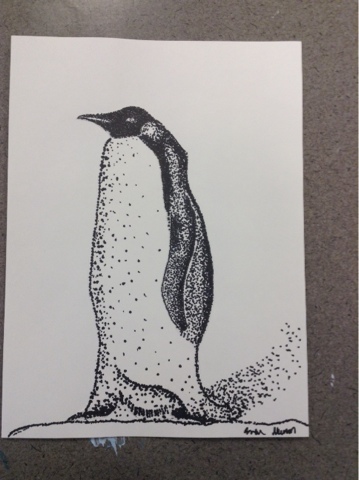
I have always been a huge fan of the impressionist and post-impressionist artists.  And in my opinion you can not have an Art 1 art history class without a stop at Georges Seurat.  I just love the mix of colors and the technique and I love telling kids the size of his paintings and how it was all done in dots the size of their pencil erasers.

Did you just stop reading to look at your pencil eraser to see how big that is?  Maybe not, but just stop and think about how you would paint a 20x30 painting with your eraser.  Most of us would give up.

Anyways, I don't really have any practice projects before they start the final. Maybe you have one, and if so please share.  So here are the final projects from Art 1.

Logan G.

Brock N.


Dylan M.

John S.


Thursday, February 11, 2016

Finished water colors

Do you ever have a medium that you love to work with, but have a heck of a time trying to teach?  Well watercolor is mine.  I can do some amazing paintings, and I love the simplicity and relaxation that watercolors bring, but to try to teach that to a group of high strung teenagers (maybe it is just my classes this year) can be hard to do.

We did so many practices that by the time they got to the final project, most of them seemed to forget what they learned on the first project.  So if anyone out there has some ideas of how to get teenagers to remember what they learn, feel free to comment.  I'm sure we all would like to know that info.  I bet you could charge a fortune for that info.

Anyways, these are a few of my favorite watercolor projects that will not be so easily forgotten.


Mercedes F.

John S.

Josh H.